1. Introduction
ince time immemorial and still today man has been feeling the need to compute, count, store and get accurate results all the time and always. It is quite apparent and significant that in our daily life, we need to keep written records what we have done in the past, basically in the form of numerals to increase productivity, growth and efficiency. In the past, man had felt the need to prepare navigational table, logarithmic table and trigonometric table for which the man himself was not efficient. From the history of computational work done in the past, man has observed the following shortcomings/limitations/demerit in the manual computational work. The demerits include: a) man/woman cannot work continuously for a longer period of time. b) Problem of short memory (memory loss) c) repetitive task is boredom d) results are prone to error (problem of inaccuracy) e) not efficient for scientific calculation.
In order to find the solution of the above problems, man has been continuously searching and inventing machine to replace man with machines to get the desired and accurate result. So in this paper, some of the early but significant achievements of man in the field of computing have been enumerated as under.
Author : Sam Higginbottom Institute of Agriculture, Technology & Sciences, Allahabad. E-mail : [email protected] II.
2. Definition a) Computer in the past
The term 'computer' is derived from the Latin word "computare" meaning to calculate. In the past, computer is restricted only to arithmetic calculations.
3. b) Computer in modern form
Computer is defined as an advanced electronic device that takes raw data as input from the user and process these data under the control of set of instructions called program and gives the result called output and saves output for the future use.
4. III.
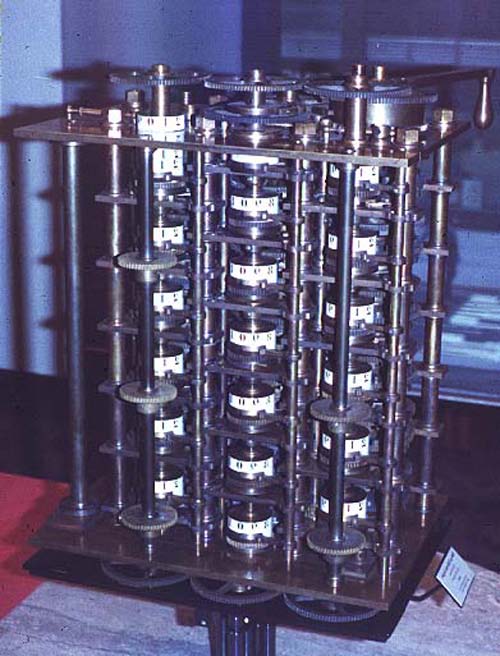
Early computers a) Computers before 300BC Men/Women: ---During this period, the word computer was used to describe human beings (basically women).Their primary job was to perform the repetitive calculations like navigational tables, tide charts and planetary positions for astronomical almanacs. Therefore, we can say that a group of intelligent women were first computers. Charles Babbage: The English mathematician proposed a stream driven calculating machine called the Difference engine. The machine would be able to compute tables of numbers, such as logarithmic table. But unfortunately the project of Difference Engine failed due to over expense. Soon after Babbage had introduced a new machine called Analytic Engine powered by six steam engines. In this project Babbage had used punched card to store numbers for future use and a mechanism to get result. Charles Babbage had divided Analytic Engine into two parts the "store" and the "Mill". The term "store" indicates the place where numbers are held and the "Mill" indicate the place where numbers are processed to give new results. The development of the Analytic engine with the idea of "store" and "Mill" is considered as the major breakthrough in computer history because in a modern computer the same kind of parts are called the memory unit and the central processing unit (CPU).Due to this reason only, he is called the father of modern computer.
5. h) 1890
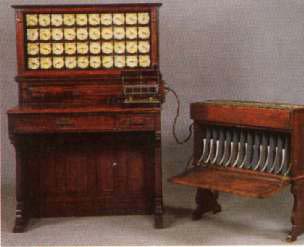
Hollerith: He had the insight to convert punched card to what is today called a read/write technology. Hollerith built a company, the tabulating machine company which after a few buyouts eventually became International Business machines, known today as IBM. ? IBM and Apple introduced computers for the home users. ? Desktop computers were introduced in this generation. ? Computers became more powerful. Computers could be linked together to form networks which eventually led to the development of the internet. ? GUI (Graphical User Interface), the mouse and handheld devices have been introduced. ? Extensive use of computer software based on the conversion of high level language into machine readable language called low level language. More RAM the computer has, the better will be its speed and performance. The speed of the RAM connection directly controls how fast the computer can access instructions and data. Therefore, it has a big effect on system performance. Much of the memory available today is dual data rate (DDR) memory. This means that the memory can transmit data twice per cycle instead of once, which makes the memory faster.
6. Generations of Electronic Computer
ii. Design of advanced motherboards
? Newer motherboards provide facility to connect to the north bridge via a dual bus instead of a single bus. This reduces the amount of time it takes for the processor to get information from the memory. ? Newer motherboards provide space or slots for multiple memory chips to increase computer speed.
7. iii. Design of microprocessor
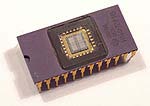
As we increase the number of transistors, the processor become faster. The drastic increase in number of transistors resulted in tremendously fast processors. For instance, in 1971 the Intel 4004 chip contained 2300 transistors only and was considered as a very slow processor. But in 1993 the Intel had launched a very fast processor namely Pentium chip that contained 3,100,000 transistors. The following technologies have been employed to increase the number of transistors in ac IC or a chip. These are commonly referred to as generations of IC. and pattern recognition. The approach definitely remove the demerits of fourth generation computer and will prove to be a more reliable and versatile machine ever made by mankind. The new techniques used to achieve the above target are Artificial Intelligence (AI), voice recognition, quantum computation and Nanotechnology. Here, we first try to understand the following terms one by one.
ii. Artificial Intelligence (AI) It is a branch of science that believes in making computers or machines that can find solutions to complex problems in a more human like fashion. Research on AI has focussed chiefly on the following components of intelligence: learning, reasoning, problem solving, perception and human language understanding.
iii. Applications of Artificial Intelligence (AI)
? Advance computer game playing and robotics pets.
? Speech recognition by a computer ? Understanding natural language by a computer ? Identifying 3 dimensional objects by a computer ? Developing expert system in medical science by a computer iv. Voice recognition Voice recognition refers to the ability of a machine to receive and interpret dictation, words or phrases spoken by humans. It is the technology by which sounds, words, phrases and sentences spoken by humans are converted into electrical signals, and these signals are transformed into coding patterns to which meaning has been assigned. Efforts have been made to speak a word or phrase into a microphone, then the electrical signal from the microphone is digitized by an "analog to digital (A/D) converter" and is stored in memory. Here the spoken words are considered as an input to a computer program. This technology will definitely eliminate peripherals like keyboard and mouse from computer system. v. Quantum computing It is the area of study focussed on developing computer technology based on the principles of quantum theory, which explains the nature and behaviour of energy and matter on the quantum (atomic and subatomic) level. Development of a quantum computer would mark a leap forward in computing capability far greater than that from the Abacus to a modern day super computer, with performance gains in the billion fold realm and beyond. The quantum computer, following the laws of quantum physics, would gain enormous processing power through the ability to be in multiple states, and to perform tasks using all possible permutations simultaneously. The concept and an approach to quantum computing is still under research and development.
8. vii. Applications of Nanotechnology
? Scientists are trying to build machines on the scale of molecules. For instance, a few nanometre wide motors, robot arms and a complete computer far smaller than a cell. ? A computer using nanotechnology can make copies of data files -essentially as many copies as we want at little or no cost.
9. viii. Natural language
Natural language is defined as any human language. Example: English, French, Chinese, Hindi etc. Scientists are trying to replace programming languages like FORTRAN, BASIC, C, C++, Java with natural language.
VII.
10. Conclusion
This paper describes the need and emergence of a machine like computer. Efforts have been made to describe the different stages of development of computer right from since time immemorial to 2012 and beyond. With the passage of time man has witnessed different forms of computer with much more improved capability. Development of computer has witnessed major technological changes and more sophisticated techniques have been employed to present a much better computer than the past. This paper also laid emphasis on the role played by the major contributors in the development of a more advanced, sophisticated and portable machine.
VIII.


![Fig. 4 : An original set of Napier's Bones [Photo courtesy IBM]](https://computerresearch.org/index.php/computer/article/download/100502/version/100502/1-Early-Computer-VS-Modern_html/7560/image-4.png)

![Fig. 11 : Babbage's Difference Engine [photo 2002 IEEE]](https://computerresearch.org/index.php/computer/article/download/100502/version/100502/1-Early-Computer-VS-Modern_html/7563/image-7.png)


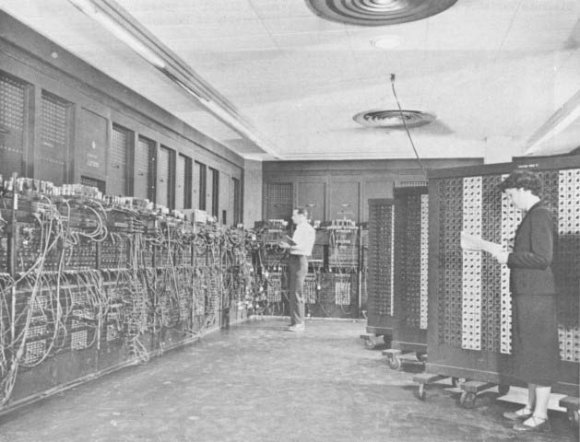
![Fig. 13 : ENIAC [U.S Army photo]](https://computerresearch.org/index.php/computer/article/download/100502/version/100502/1-Early-Computer-VS-Modern_html/7566/image-10.png)
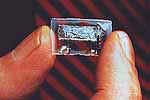
![Fig. 18 : An integrated circuit (silicon chip) [photo courtesy of IBM] i. Importance of IC in modern computer development The impact of this tiny chip has been far reaching. The chip virtually created the modern computer industry, transforming past room size machines into today's array of mainframes, minicomputers and personal computers.V.](https://computerresearch.org/index.php/computer/article/download/100502/version/100502/1-Early-Computer-VS-Modern_html/7567/image-11.png)